I Stopped at GitHub Issues — Planning a Feature Before Writing Code
After skipping /to-spec in faruk-base2, I ran the full Matt Pocock skills path on a greenfield idea. Six GitHub issues, a label system, and a dependency chain — no implementation yet.
In the previous article, I rebuilt a Java CRUD in one session and skipped /to-spec and /to-tickets. Grilling closed the scope; we went straight to /implement.
That was the right call for a revalidation. It would be the wrong call for a greenfield feature that spans multiple sessions — exactly the case I wanted to test next.
So I started zoora: a procedural 3D creature generator (TypeScript, Vite, Three.js). The product idea lives in plan.md. There is no application code yet. What exists is a planning artifact you can delegate: six open GitHub issues, a milestone, labels, and native dependency edges between tickets.
This post is about that planning layer — not the Three.js implementation.
Why zoora exists
faruk-base2 taught me that skills route behavior, but the path you pick matters:
| Session type | Path I used | Outcome |
|---|---|---|
| Revalidate existing example | /grill-with-docs → /implement | 17 decisions, one commit, same session |
| Greenfield multi-session build | /grill-me → /to-spec → /to-tickets → GitHub | Spec + ticket chain, zero lines of app code |
Zoora is the second row. The core promise from plan.md:
One seed produces a deterministic, visually unique creature.
Architecture is fixed before any ticket runs:
SEED → PRNG → CreatureGenerator → CreatureDefinition → GeometryBuilder → Three.jsCreatureDefinition is pure data — no Three.js types. That separation is in the spec, not in code yet.
The workflow I actually ran
Same harness as faruk-base2 (Matt Pocock’s skills, local router /ask-fmz). Different branch of the diagram:
flowchart TD
  A["/ask-fmz"] --> B["/grill-me<br/>No codebase yet"]
  B --> C["Shared understanding<br/>plan.md sections 1–12"]
  C --> D["/to-spec<br/>.scratch/creature-generator/spec.md"]
  D --> E["/to-tickets<br/>5 tracer bullets + blockers"]
  E --> F["migrate-to-github-issues.ps1<br/>Labels, milestone, dependencies"]
  F --> G["GitHub Issues #1–#6<br/>ready for agents or humans"]
/grill-me instead of /grill-with-docs — there was no repo to read, only an idea. The interview locked stack (TypeScript, Vite, Three.js r160+), determinism rules (no Math.random() in generation), test scope (Vitest on the data layer), and explicit out-of-scope items (game mechanics, backend, GLTF imports).
/to-spec synthesized the conversation into a PRD under .scratch/creature-generator/spec.md: problem statement, user stories, implementation decisions, testing decisions, out-of-scope list.
/to-tickets broke Phase 1 into five end-to-end slices — each ticket delivers observable behavior, not a horizontal layer:
| Ticket | Title | Blocked by |
|---|---|---|
| #2 | Scaffold Vite + Three.js + UI shell | — |
| #3 | PRNG and SeedGenerator | #2 |
| #4 | CreatureDefinition + CreatureGenerator | #3 |
| #5 | GeometryBuilder + MaterialGenerator | #4 |
| #6 | UI Generate, Randomize, copy seed | #5 |
Then a one-time script (scripts/migrate-to-github-issues.ps1) published everything to GitHub: labels, milestone, issues, native blocked_by dependencies, and a Project board.
What landed on GitHub
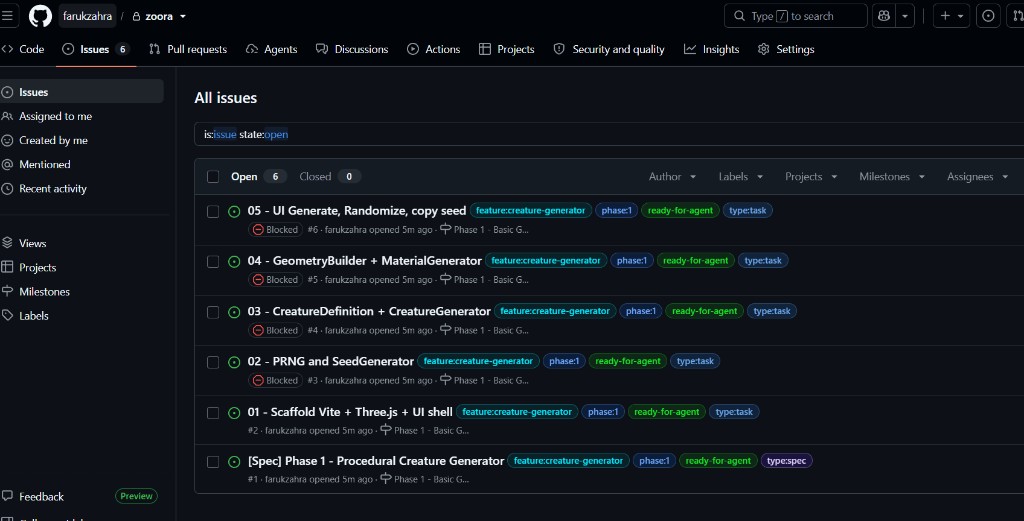
Open the board: github.com/farukzahra/zoora/issues
Issue #1 — the spec
#1 [Spec] Phase 1 - Procedural Creature Generator is the parent PRD. Labels: type:spec, ready-for-agent, phase:1, feature:creature-generator. Its body links child tasks (#2–#6) and points to the full spec file in the repo.
Every implementation ticket starts with Part of #1 — agents and humans know where acceptance criteria live.
Issues #2–#6 — tracer bullets
Each task issue carries the same label set except type:task:
- #2 is unblocked — the only ticket that can start today.
- #3–#6 show GitHub’s native Blocked badge via issue dependencies API, plus a
Blocked by: #Nline in the body as fallback.
That chain is deliberate. Ticket #3 (PRNG) does not wait for the full UI; it waits for a Vite shell that can run Vitest. Ticket #6 (UI wiring) waits for geometry — you cannot demo Generate/Randomize without meshes.
Milestone and project
All six issues sit in milestone Phase 1 - Basic Generator (Seed → deterministic CreatureDefinition → Three.js prototype). A GitHub Project board groups them for kanban-style tracking: Project #2.
The label system
Labels are the contract between planner, implementer, and triage. Custom labels created for zoora:
| Label | Color | Meaning |
|---|---|---|
type:spec | purple | PRD / specification — not directly implementable |
type:task | blue | Implementation work item |
ready-for-agent | green | Fully specified; safe for an autonomous agent |
ready-for-human | yellow | Needs human judgment (not used on Phase 1 tickets) |
needs-triage | pink | Maintainer must evaluate before work starts |
needs-info | blue | Waiting on reporter input |
phase:1 | blue | Milestone slice — basic generator only |
feature:creature-generator | teal | Product area tag for filtering |
wayfinder:map | light blue | Reserved for /wayfinder decision maps (future) |
Workflow labels (ready-for-agent vs needs-triage) let you filter with:
gh issue list --state open --label ready-for-agentIssue templates under .github/ISSUE_TEMPLATE/ (spec.yml, task.yml) pre-fill label sets for manually created issues.
Delegating to agents or people
The point of stopping at issues — without implementing — is handoff surface.
For another Cursor agent
- Open zoora, read
AGENTS.mdanddocs/agents/issue-tracker.md. - Pick the oldest unblocked
ready-for-agenttask: #2. - Run
/implementagainst that issue (the skill pulls acceptance criteria from the linked spec and scratch files). - Open a PR referencing
Closes #2, run CI, merge. - #3 unblocks automatically when the dependency resolves.
Each ticket is scoped for a fresh session — Matt’s harness assumes new context per issue, not one mega-prompt for all five.
For a human contributor
Same filter: gh issue list --label ready-for-agent --label type:task. Claim with gh issue edit 2 --add-assignee @me. The spec (#1) and local scratch files (.scratch/creature-generator/issues/01-scaffold-vite-three.md) hold the detailed acceptance checklist the GitHub body summarizes.
What /triage is not for
Skills docs are explicit: /triage is for issues you did not create. Tickets from /to-tickets already went through grilling — they skip triage and land as ready-for-agent.
Local scratch vs GitHub as source of truth
During planning, artifacts lived in .scratch/creature-generator/:
.scratch/creature-generator/
├── spec.md
└── issues/
    ├── 01-scaffold-vite-three.md
    ├── 02-prng-seed-generator.md
    └── ...
After migration, GitHub Issues are canonical for new work. The scratch files remain as rich detail (acceptance checklists, Vitest requirements); the issues link back to them. docs/agents/issue-tracker.md documents API conventions, dependency creation, and wayfinder operations.
Example from the local ticket file — detail that fits a spec but not a GitHub title:
What to build: SeedGenerator that normalizes seed (string or number) into a deterministic PRNG.
random(),randomRange(), andrandomInt()must be reproducible. Vitest proves a stable sequence and thatMath.random()is not used in the public API.
The GitHub issue body stays short; the scratch file holds the checklist.
What I deliberately did not do
- No /implement yet — this article stops at the backlog.
- No prototype —
/prototypeis for throwaway spikes when you need to see something before specing. Here,plan.mdalready had enough structure for grilling. - No code in the blog repo — zoora is an external repo, linked in prose (same pattern as faruk-base2).
Next step when I (or someone else) picks this up: /implement on #2, validate npm run dev, merge, watch #3 unblock.
What I take from this
The previous article’s footnote was the roadmap. “For a multi-day build with blocking edges, I would take the longer path.” Zoora is that path, documented end-to-end.
Issues are the API between sessions. Grilling captures intent; /to-spec freezes it; /to-tickets cuts vertical slices; GitHub adds visibility, dependencies, and filters. An agent without chat history can start from issue #2 alone.
Labels are cheap routing. ready-for-agent is not vanity — it is the signal that grilling and spec work are done, and autonomous work will not guess missing requirements.
Planning is shippable. Six issues, zero app code, and the project is already legible to another person or agent. That is the outcome I wanted to show.
Repo: zoora. Issues: #1–#6. Skills harness: faruk-base2 / mattpocock/skills. Previous session: I Tested Matt Pocock’s Agent Skills.
Comments
Comments powered by GitHub — sign in to join the discussion.